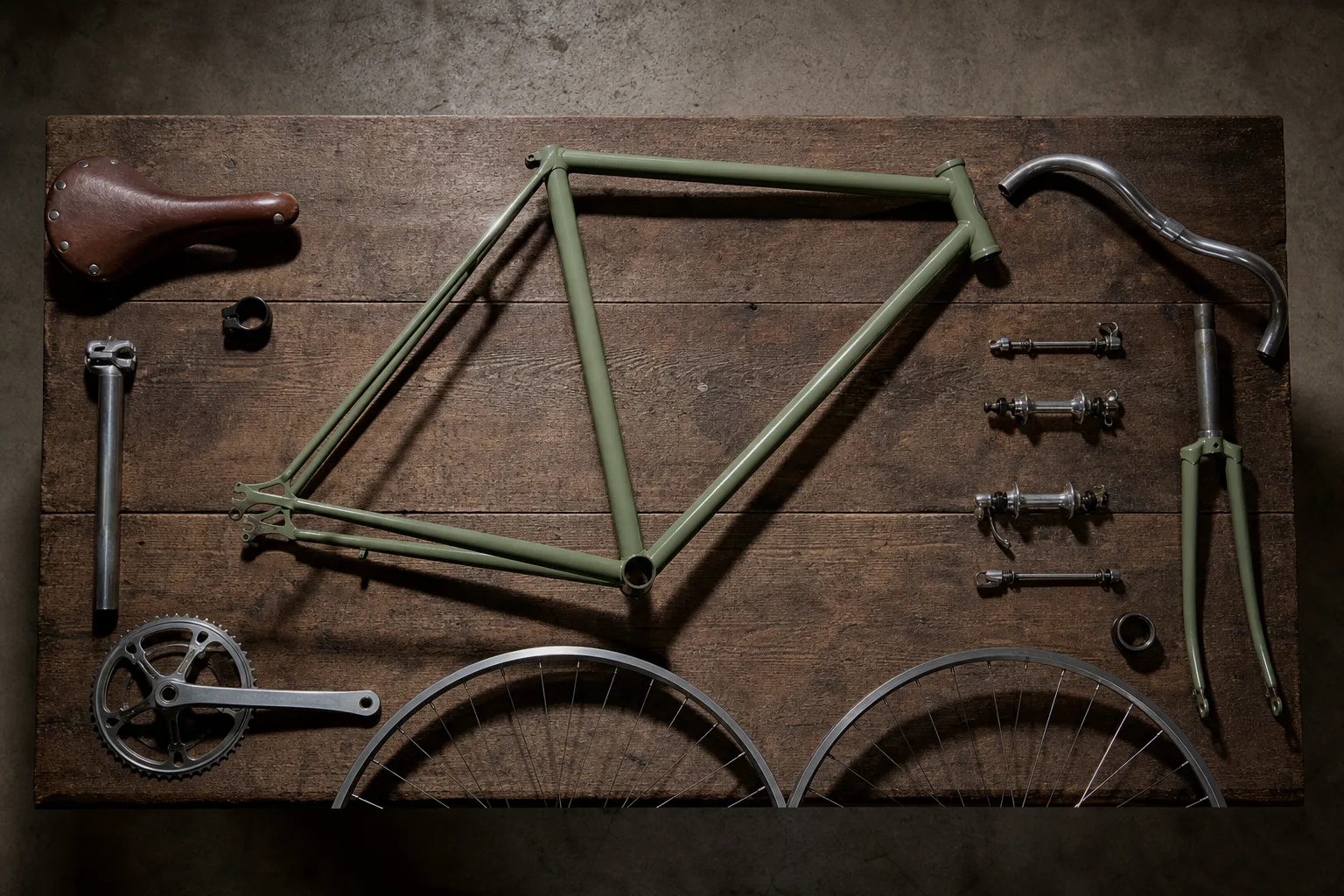
Sit on an upright bicycle and almost nothing rests on your hands. That is the whole design argument in one sentence, and everything else about the frame exists to make it true: the handlebar sweeps back toward you so your wrists stay neutral, the seat tube leans further from vertical than it does on a road bike, and the chainstays, the two tubes running from the pedals back to the rear axle, are long enough to push the back wheel well behind the saddle. Your torso ends up close to vertical, your weight lands on your sit bones, and your palms are just steering.
What the geometry is actually solving
The complaint that sends most people looking at a new bicycle is not speed. It is numb hands after twenty minutes, or a sore neck from craning up to see traffic, or the feeling of being tipped forward over the front wheel every time the brakes come on. Upright geometry answers all three at once, and it answers them structurally rather than with padding. Weight that never reaches your hands cannot make them go numb. Eyes that are already level do not need a neck extension to read an intersection. Longer chainstays and a rearward saddle keep your center of mass behind the front hub during a stop.
The ride quality follows from wheelbase, the distance between the two axles. A long wheelbase settles down over railroad tracks, expansion joints and the lip where a driveway meets the street, because the front wheel has finished dealing with the bump before the back wheel arrives. Steering gets slower in a way that reads as calm rather than dull. You can look over your shoulder for a car without the bike wandering. Balloon tires, meaning fat tires run at low pressure, add another layer of absorption that a stiffer frame would transmit straight into your spine.
The first problem: any sustained climb
Put that same bicycle on a real hill and the arrangement works against you. Climbing rewards a rider who can get body weight over the pedals and pull against the bars, and upright geometry deliberately prevents both. Your hips sit behind the crank, the swept bars are too close and too high to brace against, and standing up shifts weight so far back that the front wheel goes light and the steering turns vague. The frame itself is usually heavy steel, often thirty-some pounds with fenders and a rack, and a single-speed drivetrain gives you no gear to retreat into.
The cost of that is a decision, not a defect. If your route has one modest rise, an internally geared three-speed hub covers it, and the price gap between a single-speed and a three-speed version of the same model is typically the difference between a bike you push up the hill and one you ride. If your route has grade you would describe as a hill without hedging, this is the wrong frame, and no parts swap fixes it cheaply.
The second problem: distance and headwind
The other place the design runs out is duration. An upright torso is a sail, so a steady headwind costs noticeably more effort than it would on a bike that lets you fold down, and there is no second hand position to move to. Swept bars give you one grip, which is comfortable for thirty or forty minutes and monotonous after two hours, because every contact point stays loaded the entire time. All of your weight also sits on the saddle continuously rather than shifting between three points, which is why saddle width and suspension matter far more here than on a bike where the hands share the load.
Most riders shopping Cruiser Bikes are honestly describing a two mile errand and a flat waterfront path, and for that use the limitation never appears. The mistake is buying the geometry and then asking it to do a twenty mile weekend ride, which ends with a sore backside and a conclusion about the bike that is really a conclusion about the route.
What the trade actually costs in dollars
Reversing this later is expensive relative to the price of the bike. Changing hand position means a new handlebar, new grips, usually a new stem and often longer cables and housing, plus labor if you are not doing it yourself, and the total can approach a meaningful fraction of what an entry-level bike cost in the first place. Adding gears to a single-speed frame means a new rear wheel with a geared hub, a shifter, a cable and a brake rethink if the original stopping was done by a coaster brake in that same hub.
The cheap adjustments are the ones to make first: saddle height, saddle fore and aft position, bar rotation, tire pressure. Those cost nothing and change more than people expect. The Consumer Product Safety Commission is responsible for the federal requirements that govern bicycles sold in the United States, including braking and reflector rules, which is worth knowing before you start replacing components that were specified to meet them. Buy the geometry that matches the terrain you actually have, and the money stays where it belongs, in the frame, the wheels and the tires.
An upright frame is a specialist. It is built for short, flat, unhurried trips where comfort at low speed matters more than efficiency at any speed, and inside that job it is very hard to beat. Match it to the ride you take three times a week rather than the one you imagine taking in June.